
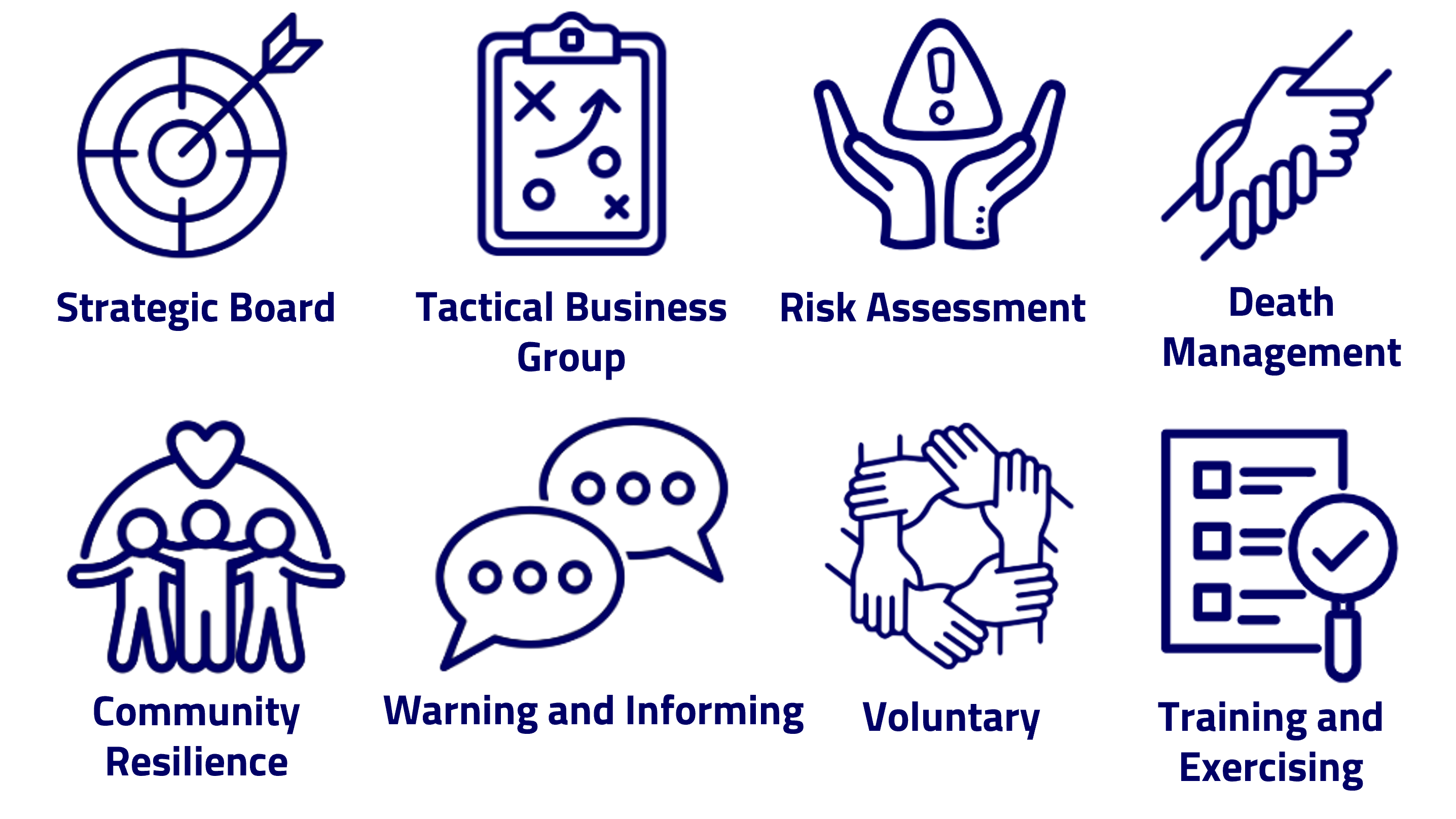
Each of our working groups play a very important role in the joint work that we do. All groups report into the Tactical Business Group which is held once a quarter across the financial year, with updates given by the working group chairs.
Strategic Board
The Strategic Board is a multi-agency group responsible for setting the strategic direction for the LRF. It is chaired by the Chief Fire Officer of County Durham and Darlington Fire and Rescue Service, with Durham Constabulary, as the vice chair. Membership of the group consists of Chief Executive level officers from Category 1 responders and other key LRF partners such as the military and the voluntary sector. Provides strategic direction to ensure local resilience in line with the requirements of the Civil Contingencies Act 2004, ensuring coordination, resourcing and accountability for the LRF work programme from all LRF partners.
Tactical Business Group
The Tactical Business Group is responsible for implementing the strategic direction set by the Strategic Board and serves as the operational “engine room” of the LRF. Meeting quarterly, the group oversees the delivery of agreed priorities, monitors progress against work programmes, identifies emerging risks and issues, and ensures effective coordination across the partnership. It provides a key link between the Strategic Board and specialist working groups, enabling information sharing, problem solving, and collaborative decision-making. Membership includes representatives from partner agencies and leads from relevant working groups, ensuring that operational activity remains aligned with the LRF's strategic objectives and statutory responsibilities.
Risk Assessment Working Group
The group provides a forum for partner agencies to share knowledge, expertise, intelligence and information relating to current and emerging risks, enabling a coordinated and evidence-based approach to risk assessment, preparedness and risk management across the partnership. Through regular collaboration, members are able to identify trends, share lessons learned and develop a common understanding of the threats and hazards facing the area. The group reviews the National Security Risk Assessment (NSRA) and other relevant national, regional and local risk information on a regular basis, in line with Cabinet Office guidance. It considers the potential impact of identified risks on communities, essential services and partner organisations, ensuring that appropriate preparedness and response measures are developed and maintained.
Death Management Group
The Death Management Group provides a safe and collaborative forum for key partners involved in the deceased management pathway across County Durham and Darlington. The group brings together representatives from relevant organisations to share information, maintain situational awareness, identify challenges, and develop coordinated approaches to planning and preparedness. During a mass fatalities or excess deaths incident, the group meets as required to coordinate and support a multi-agency response. This includes facilitating effective communication between partner organisations, identifying resource requirements, addressing operational issues, and ensuring that arrangements are in place to manage the deceased with dignity, sensitivity and respect, while supporting bereaved families and affected communities.
Community Resilience Group
The principal aim of the group is to provide a forum through which community resilience can be developed, strengthened and promoted across the County Durham and Darlington LRF area. Working within the principles and parameters of HM Government’s Community Resilience Framework, the group brings together partners to encourage collaborative working, share best practice, and identify opportunities to enhance local resilience capabilities. The group supports communities to better understand local risks and hazards, increase preparedness and helps build stronger links between community organisations. It also seeks to identify and support vulnerable communities, encourage the development of community emergency plans, and facilitate the sharing of resources, knowledge and learning to improve readiness for emergencies.
Warning and Informing Group
The Warning and Informing Group is responsible for ensuring that effective, timely and consistent information is communicated to the public before, during and after emergencies. The group works collaboratively to help communities understand local risks, improve preparedness, and provide clear guidance on the actions they should take to protect themselves and others. Bringing together communications and resilience professionals from across the Local Resilience Forum, the group develops and maintains warning and informing arrangements, promotes coordinated messaging, and supports the delivery of accurate and accessible public information. During incidents, the group helps ensure that communities receive clear, reliable and timely updates, while supporting partner organisations to maintain public confidence.
Voluntary Emergency Liaison Group
The Voluntary Emergency Liaison Group (VELG) has a long history of supporting the emergency services and partner agencies in responding to a wide range of incidents. Members can be activated, tasked and deployed directly by blue light services, although activation is traditionally coordinated through the Civil Contingencies Unit Duty Officer to ensure an effective and coordinated response. The group promotes strong collaboration between the voluntary sector and CDDLRF before, during and after emergencies, helping to ensure that voluntary sector capabilities are understood, integrated into local resilience arrangements, and available to support communities when needed. Through partnership working, planning and information sharing, VELG helps enhance the overall resilience of the LRF.
Training and Exercising Group
This group is responsible for coordinating training and exercise activity across County Durham and Darlington, ensuring that partner organisations are prepared to respond effectively to emergencies. The group develops and delivers relevant training and exercising programmes for members of the LRF, helping to build capability, strengthen partnerships and enhance understanding of roles, responsibilities and procedures. The group also seeks to maximise the use of collective resources by promoting joint training and exercising opportunities across organisations. Through the planning, delivery and evaluation of exercises, it supports continuous improvement, identifies lessons learned and helps embed the Joint Emergency Services Interoperability Principles (JESIP), ensuring a coordinated and effective multi-agency response to emergencies.